Harmony in the Classroom: The Transformative Power of Music Lessons at School
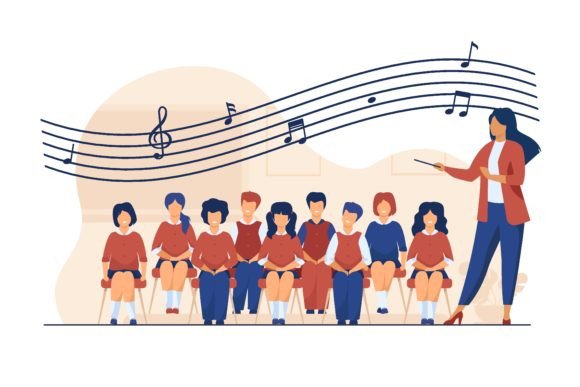
In the bustling ecosystem of modern education, where academic rigor often takes center stage, there exists a vibrant corner where rhythm, melody, and harmony converge to create something truly magical. Imagine a scene rendered in bright, flat vector art: a spirited conductor, baton raised high, leading a choir of singing children. This is not just an illustration; it is a snapshot of music lessons at school, a fundamental component of holistic child development. These sessions are far more than mere extracurricular hobbies; they are essential educational experiences that shape cognitive abilities, foster emotional intelligence, and build lifelong social skills.
As we delve into the world of school music education, we uncover a landscape where creativity meets discipline. From the first tentative note played on a recorder to the soaring crescendo of a full orchestral performance, music lessons provide a unique platform for students to explore their potential. Whether you are a parent considering enrichment activities, an educator designing a curriculum, or simply someone curious about the benefits of the arts, understanding the depth of music education is crucial.
The Foundation: What Are Music Lessons at School?
At its core, a music lesson in a school setting is a structured period dedicated to teaching students the theory, history, and practical application of music. However, the scope is incredibly broad. It encompasses everything from vocal training and choral singing to instrumental instruction, composition, and music appreciation. Unlike private tutoring, which often focuses on individual technique, school music programs emphasize collaboration and community.
Consider the classic image of a classroom transformed into a concert hall. Here, a teacher acts as the maestro, guiding a diverse group of learners. Some students might be learning to read sheet music for the first time, while others are refining their pitch or exploring the mechanics of percussion instruments. The environment is designed to be inclusive, encouraging every child to participate regardless of their prior experience. This accessibility is what makes school music programs so vital; they democratize the arts, ensuring that musical literacy is available to all, not just those who can afford private instruction.
Key Components of a Comprehensive Program
- Vocal Training: Developing breath control, pitch accuracy, and ensemble singing skills through choirs and group songs.
- Instrumental Instruction: Learning specific instruments such as strings, woodwinds, brass, or keyboards, often starting with beginner-friendly options like recorders or ukuleles.
- Musical Theory: Understanding the building blocks of music, including rhythm, scales, key signatures, and notation.
- History and Appreciation: Exploring different genres, cultural traditions, and the evolution of music throughout human history.
- Composition and Technology: Using modern tools to create original pieces, bridging the gap between traditional musicianship and digital innovation.
Why Music Matters: The Cognitive and Emotional Benefits
The significance of integrating music into the school curriculum cannot be overstated. Research consistently shows that engaging in music education yields profound benefits that extend far beyond the ability to play a song. When children engage in music, they are essentially giving their brains a full-body workout. The act of reading music, coordinating fine motor skills to play an instrument, and listening critically to harmonies activates multiple areas of the brain simultaneously.
One of the most compelling arguments for music lessons is their impact on cognitive development. Studies suggest that students involved in music programs often demonstrate improved memory, enhanced mathematical reasoning, and better language acquisition skills. The patterns found in music mirror those in mathematics, helping children grasp complex concepts like fractions and ratios in a tangible, auditory way. Furthermore, the discipline required to practice an instrument fosters patience and perseverance—traits that are invaluable in academic subjects and future careers.
Beyond the intellect, music serves as a powerful vehicle for emotional expression. In a school environment that can sometimes feel high-pressure, music offers a safe space for children to process their feelings. Singing in a choir or playing in a band allows students to express joy, sorrow, and excitement without saying a word. This emotional outlet is critical for mental health, helping to reduce anxiety and build self-confidence. As the conductor leads the choir in our imagined illustration, each child finds their voice, contributing to a collective sound that is greater than the sum of its parts.
Fostering Community and Social Skills
Music is inherently social. A solo performance requires focus, but an ensemble requires cooperation. In a school music program, students learn the art of listening—not just to themselves, but to one another. To create a harmonious sound, a violinist must adjust their tempo to match the cellist, and a singer must blend their tone with the rest of the choir. This collaborative dynamic teaches empathy, active listening, and the importance of working toward a common goal.
These lessons translate directly into real-world scenarios. The teamwork learned in the school orchestra mirrors the collaboration needed in business projects, community initiatives, and family life. Students learn that their individual contribution matters, but it must align with the group's vision to succeed. Moreover, music breaks down barriers. It brings together children from different backgrounds, ages, and abilities, creating a sense of belonging and shared identity. In a world that often feels divided, the universal language of music remains a unifying force.
Music Education in the Modern World
As we navigate the 21st century, the relevance of music education continues to evolve. The integration of technology has opened new doors for creativity and learning. Digital audio workstations (DAWs), virtual instruments, and online collaboration platforms allow students to compose and produce music in ways that were previously impossible. Modern music lessons now often include coding for music, sound design, and the study of electronic genres, preparing students for careers in the booming creative industries.
Furthermore, the concept of "creative hobbies" has gained traction in discussions about workforce readiness. Employers increasingly value soft skills such as creativity, adaptability, and problem-solving—all of which are honed through music. A student who learns to improvise on a piano develops the ability to think on their feet, a skill highly prized in dynamic professional environments. Thus, music education is not a distraction from "real" academics; it is a complement that enhances overall preparedness for the future.
Common Misunderstandings About School Music
Despite its clear benefits, several misconceptions persist regarding music in schools. Let's clarify a few common assumptions:
- "Only talented kids should do music." This is perhaps the most harmful myth. Music education is for everyone. Just as physical education helps children develop gross motor skills regardless of athletic prowess, music education helps develop auditory and cognitive skills regardless of innate talent. The goal is growth, not perfection.
- "Music takes time away from core subjects." On the contrary, studies show that music students often perform better in math and reading. The neural pathways strengthened by music support learning across the board.
- "It's just a fun break." While music is enjoyable, it is rigorous. Learning an instrument requires dedication, practice, and intellectual engagement comparable to mastering a foreign language or a science subject.
Bringing the Joy of Music Home and Into the Future
The vibrant energy captured in a simple illustration of a conductor and choir reflects a deeper truth: music is life-affirming. When schools prioritize music, they are investing in the emotional and intellectual well-being of their students. They are creating an environment where children can discover their passions, build resilience, and connect with others.
For parents and educators, supporting music education means advocating for robust budgets, diverse instrumentation, and qualified instructors. It means recognizing that a child humming a tune or tapping a rhythm is engaging in a sophisticated form of learning. By valuing these moments, we ensure that the next generation grows up not only with knowledge but with the capacity to create, to feel deeply, and to find joy in the harmony of life.
Ultimately, the story of music lessons at school is a story of transformation. It is about taking a room full of individuals and turning them into a cohesive, resonant whole. Whether through the strumming of a guitar, the blowing of a flute, or the unified voice of a choir, music education leaves an indelible mark on a child's character. As we look toward the future, let us champion the arts, ensuring that every child has the opportunity to pick up a baton, raise their voice, and discover the boundless possibilities of music.
From the quiet concentration of a student practicing scales to the thunderous applause of a school recital, the journey of music education is filled with moments of discovery and connection. It is a testament to the power of creativity and the enduring spirit of youth. So, the next time you see a conductor leading a choir, remember: you are witnessing the cultivation of the mind, heart, and soul of the future.