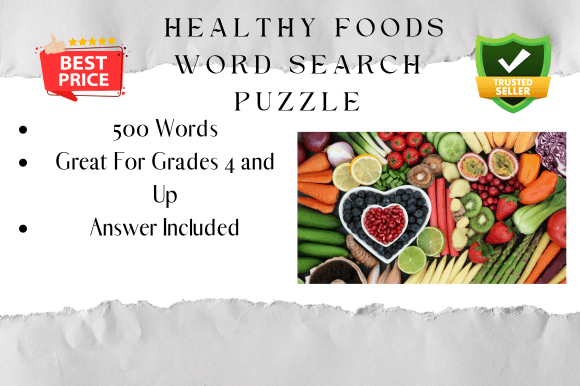
Healthy Foods Word Search: A Practical Tool for Nutrition Education
In the landscape of classroom resources and educational materials, few tools manage to bridge the gap between engagement and instruction as effectively as a well-designed word search. The Healthy Foods Word Search is not merely a pastime activity; it is a strategic component of a broader curriculum designed to instill lifelong habits regarding nutrition. For educators, parents, and content creators looking to demystify the concept of "eating well," this resource offers a tangible starting point. It transforms abstract nutritional guidelines into an interactive experience that students can grasp immediately.
The core value of this material lies in its ability to normalize the vocabulary of healthy eating. When children or adults encounter terms like "quinoa," "kale," or "legumes" within the context of a puzzle, the barrier to trying these foods often lowers. The Teacher Material Healthy Foods guide leverages this psychological principle by embedding essential food groups into a format that feels like play rather than a lecture. This approach is particularly vital in an era where processed foods dominate the market, and understanding whole-food ingredients is becoming increasingly complex.
Bridging Theory and Practice in the Classroom
For teachers managing diverse classrooms, finding activities that cater to different learning styles is a constant challenge. The Healthy Foods Word Search serves as an excellent entry point for visual and kinesthetic learners who might struggle with dense textbooks on nutrition. Instead of memorizing a list of vitamins and minerals, students actively scan for words representing fruits, vegetables, grains, proteins, and dairy options. This active retrieval process reinforces memory retention far more effectively than passive reading.
Consider a typical third-grade health lesson. The teacher introduces the concept of a balanced plate. Rather than simply drawing a diagram on the whiteboard, they distribute the word search puzzles alongside a chart illustrating food groups. As students hunt for words like "broccoli" or "chicken breast," they are simultaneously categorizing these items mentally. The accompanying activities in the Teacher Material allow for immediate application. Once the puzzle is complete, the class can discuss why those specific words were included, leading to a natural conversation about fiber, protein, and hydration.
This method is also highly adaptable for special education settings. The clear, structured nature of the word search provides a sense of accomplishment and reduces anxiety associated with open-ended questions. By focusing on identification first, educators can build confidence before moving on to more complex tasks like meal planning or analyzing nutritional labels.
Real-World Applications Beyond the Schoolhouse
While the primary audience for Teacher Material Healthy Foods is the educator, the utility of these resources extends far beyond the traditional school environment. Parents homeschooling their children find these materials invaluable for creating structured yet fun learning days. They provide a ready-made framework for teaching kids about grocery shopping and cooking without requiring the parent to be a certified nutritionist.
For camp counselors and youth group leaders, the Healthy Foods Word Search acts as a versatile icebreaker or a quiet activity during downtime at summer camps. In these settings, where attention spans can be short and energy levels high, a focused puzzle helps transition groups from physical play to reflective discussion. Counselors can use the completed puzzles as a springboard for outdoor cooking demonstrations, utilizing the simple and nutritious recipes included in the comprehensive guide to prepare snacks using the very foods the participants just identified.
Even in corporate wellness programs or community centers, these materials have found a niche. Marketers and program coordinators often struggle to make health initiatives engaging for adults. A Healthy Foods Word Search adapted for older audiences can serve as a low-pressure way to introduce new dietary concepts during lunch-and-learn sessions. It sparks curiosity and encourages employees to explore the food lists provided, perhaps leading them to try a new vegetable or swap a grain source at their next meal.
Maximizing Impact with Visual Aids and Recipes
The true power of the Teacher Material Healthy Foods package comes from its holistic design. A word search in isolation is useful, but when paired with detailed visual aids, it becomes a robust educational tool. Charts and infographics included in the guide illustrate the relationships between different food groups, helping users visualize what a balanced diet actually looks like on a plate.
These visuals are critical for translating the words found in the puzzle into real-world choices. For instance, after identifying "whole wheat" and "brown rice" in the word search, students can refer to the infographic showing the difference between refined and whole grains. This connection cements the knowledge, moving it from short-term recognition to long-term understanding.
Furthermore, the inclusion of recipes bridges the gap between knowing about food and consuming it. Many educational resources stop at theory, leaving students with information but no practical skills. This guide includes simple recipes suitable for classroom cooking demonstrations. Imagine a scenario where students solve the puzzle, identify the ingredients needed for a fruit salad or a veggie wrap, and then participate in preparing the dish. This multi-sensory experience—reading, solving, seeing, smelling, and tasting—creates a powerful memory anchor for healthy eating habits.
Choosing the Right Resources for Your Needs
When selecting educational materials like the Healthy Foods Word Search, it is important to consider the specific goals of your program or classroom. Are you aiming to improve vocabulary, change behavior, or simply fill a gap in the schedule? The versatility of this resource makes it suitable for all three, but the implementation will differ.
Educators should look for materials that offer scalability. Can the word search be used for individual work, small groups, or the whole class? Does the accompanying content align with current nutritional guidelines? The Teacher Material Healthy Foods guide addresses these needs by providing detailed lists and categorized activities that can be easily modified for different age groups. For younger children, the focus might be on recognizing colors and shapes of fruits and vegetables. For older students, the same word search can lead to deeper discussions about macronutrients and sustainable farming practices.
Parents and hobbyists should also consider the digital accessibility of these resources. In today's connected world, having printable versions available for offline use is crucial, especially for families limiting screen time. However, the ability to share these materials digitally allows for easy distribution among teacher communities and parenting groups, fostering a network of support around healthy lifestyle choices.
Fostering a Positive Relationship with Food
Ultimately, the goal of using a Healthy Foods Word Search is not just to teach a list of words, but to cultivate a positive attitude towards nutrition. Food education often carries a heavy burden of rules and restrictions, which can lead to negative associations. By approaching the topic through a game-like format, educators and parents can shift the narrative from "what you can't eat" to "what you can discover."
This shift is essential for empowering individuals to make informed dietary choices throughout their lives. When a student associates healthy foods with fun, discovery, and creativity, they are more likely to seek out those foods independently as they grow older. The Teacher Material Healthy Foods provides the scaffolding necessary to build this foundation, offering a comprehensive suite of tools that go far beyond a simple puzzle.
Whether you are a seasoned educator looking to refresh your curriculum, a parent seeking to engage your child in kitchen activities, or a community leader organizing a wellness workshop, this resource offers a practical, effective, and enjoyable path forward. It proves that learning about nutrition doesn't have to be dry or difficult; it can be an engaging journey of discovery that starts with a single word search.