Mastering 2-Digit Subtraction Without Regrouping: A Valentine-Themed Educational Journey
The intersection of foundational numeracy and seasonal engagement offers a unique opportunity for educators and parents to transform routine practice into memorable learning experiences. At the heart of early elementary mathematics lies the concept of 2-Digit Subtraction Without Regrouping S3, a critical milestone that bridges the gap between single-digit arithmetic and more complex operations. When this mathematical standard is wrapped in the vibrant, affectionate aesthetics of Valentine's Day, it creates a powerful pedagogical tool. This approach does not merely teach students how to subtract; it instills a sense of confidence and joy in tackling numbers, proving that academic rigor and thematic fun are not mutually exclusive but rather complementary forces in effective education.
The Pedagogical Value of Thematic Math Resources
Integrating themes like Valentine's Day into math curricula serves a purpose far deeper than simple decoration. For children in grades 1 through 3, abstract concepts can often feel daunting or disconnected from their daily lives. By anchoring these concepts in a familiar and beloved season, educators leverage emotional connection to enhance cognitive retention. The visual cues provided by hearts, cupids, and soft pastel colors act as anchors, reducing math anxiety and encouraging active participation. When a student sees a subtraction problem framed within a story about sharing candies or counting love notes, the task shifts from a sterile drill to a narrative they wish to solve.
This method aligns with modern educational theories that emphasize context-based learning. The specific focus on without regrouping ensures that students build a solid foundation before facing the complexities of borrowing. It allows them to internalize place value—the understanding that tens stay with tens and ones stay with ones—without the added cognitive load of manipulating digits across columns. A well-designed resource set, such as a comprehensive 60-page array of worksheets, provides the repetition necessary for mastery while keeping the experience fresh through varied illustrations and scenarios.
Building Confidence Through Scaffolded Learning
Confidence in mathematics is often built on a series of small, successful interactions. If a child encounters too much difficulty too quickly, they may develop a fixed mindset regarding their abilities. The 2-Digit Subtraction Without Regrouping S3 framework addresses this by offering tasks that are challenging enough to be engaging but accessible enough to ensure success. Each worksheet in a curated collection acts as a step on a ladder, gradually increasing in complexity without introducing new variables like regrouping.
In a classroom setting, this scaffolding allows teachers to differentiate instruction easily. Some students may breeze through the initial pages involving straightforward horizontal equations, while others benefit from the vertical alignment supported by visual aids. The consistent theme maintains continuity, so even as the problems evolve, the environment remains safe and predictable. This consistency is crucial for young learners who thrive on routine, allowing them to focus entirely on the mechanics of subtraction rather than deciphering new instructions or layouts.
Structuring the 60-Page Worksheet Experience
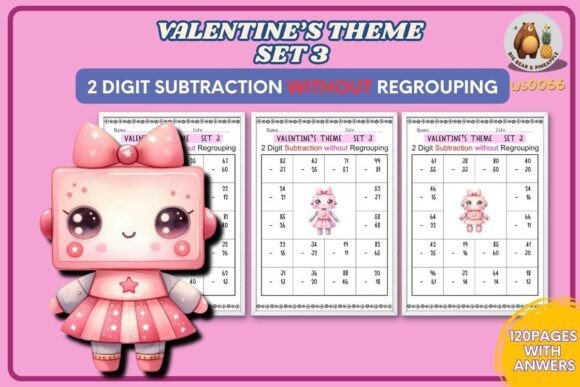
A robust collection of 60 pages is not merely a volume count; it represents a structured curriculum designed to cover various aspects of the skill set. Such a resource typically moves beyond simple computation to include diverse formats that test understanding in multiple ways. For instance, the early pages might focus on pure calculation, presenting problems like "45 - 23" alongside charming Valentine imagery. As the user progresses, the worksheets might introduce word problems where students must determine how many valentines remain after some are distributed, requiring them to extract numerical data from text.
The variety within these pages is essential for maintaining engagement over time. A monotonous list of identical problems can lead to disengagement, regardless of the theme. Therefore, a high-quality set will intersperse different types of exercises:
- Visual Matching: Connecting subtraction equations to their correct answers represented by groups of hearts.
- Crossword-Style Grids: Filling in missing numbers in a grid based on subtraction clues.
- Maze Challenges: Navigating a path through a maze by solving subtraction problems correctly at each junction.
- Color-by-Number Activities: Solving problems to reveal a hidden Valentine image, combining art and math.
This diversity ensures that the 2-Digit Subtraction Without Regrouping S3 concept is reinforced from multiple angles. Students learn that subtraction is not just a procedure but a versatile tool for solving puzzles, organizing data, and completing creative tasks. The inclusion of answer keys further enhances the utility of these resources, allowing for immediate feedback. Whether used by a teacher during a lesson or a parent at home, the ability to check work instantly helps identify misconceptions before they become ingrained habits.
Practical Applications in Diverse Settings
The versatility of themed math worksheets makes them suitable for a wide range of environments, from formal classrooms to informal homeschooling setups. In a traditional school setting, these resources serve as excellent center activities. Teachers can set up a "Valentine Math Station" where students rotate through tasks independently or in pairs. The clear, printable PDF format ensures that preparation is minimal, allowing educators to focus on facilitating learning rather than creating materials from scratch.
For homeschooling families, these worksheets provide structure and variety without the need for extensive lesson planning. Parents often seek resources that align with their child's interests, and the universal appeal of Valentine's Day makes these materials particularly effective. The 60-page scope offers enough content to sustain a week-long unit or to be spread out throughout the month of February as daily warm-up exercises. This flexibility allows families to tailor the pace to their child's specific needs, spending extra time on difficult concepts or accelerating through areas of strength.
Beyond the home and school, these resources find value in tutoring centers and after-school programs. Tutors looking to supplement their sessions with engaging, off-the-shelf materials will find that the thematic element breaks down barriers with reluctant learners. The charm of the illustrations acts as an icebreaker, making the session feel less like a remedial intervention and more like a shared activity. Furthermore, the focus on 2-Digit Subtraction Without Regrouping S3 ensures that the content remains aligned with common core standards and state requirements, providing peace of mind for professionals responsible for academic progress.
Facilitating Parent-Teacher Collaboration
Effective education relies heavily on communication between home and school. These worksheets serve as a tangible bridge between the two worlds. When a teacher assigns a specific set of Valentine-themed subtraction problems, parents receive a clear window into what is being taught in the classroom. The accompanying answer keys empower parents to assist their children effectively, even if they do not possess deep pedagogical training themselves.
This collaboration extends to tracking progress. Because the worksheets are standardized and sequential, both parents and teachers can monitor improvement over time. They can observe whether a student is struggling with specific number combinations or if the issue lies in reading comprehension when dealing with word problems. The data gathered from these exercises informs future instruction, allowing for targeted interventions that address specific gaps in understanding. The seamless integration of these tools into existing workflows ensures that everyone involved in a child's education is working toward the same goal: mathematical proficiency.
Design Elements That Drive Engagement
The visual design of educational materials plays a pivotal role in their effectiveness. For the target audience of grades 1-3, the aesthetic must be appealing without being distracting. The Valentine theme utilizes a palette of reds, pinks, and whites, which are culturally associated with love and celebration. However, the design must balance these festive elements with clarity. Text should be large and legible, and the layout must guide the eye naturally from the problem to the answer space.
Illustrations in these worksheets are not merely decorative; they serve as cognitive supports. For example, a problem asking to subtract 12 from 35 might be accompanied by an image of 35 hearts, with 12 crossed out. This visual representation helps concrete thinkers visualize the operation, reinforcing the concept of taking away. As students advance, the reliance on images may decrease, but the thematic framing remains, providing a consistent thread throughout the learning journey.
Furthermore, the digital accessibility of these resources as downloadable PDFs ensures ease of use. In an era where technology is ubiquitous, the ability to print materials instantly or display them on interactive whiteboards adds significant value. Educators can project a worksheet for whole-class instruction, then distribute printed copies for individual practice. This adaptability ensures that the resource fits seamlessly into any technological ecosystem, from low-tech classrooms to fully digital learning environments.
Long-Term Impact on Mathematical Proficiency
While the immediate goal of these worksheets is to master 2-Digit Subtraction Without Regrouping S3, the long-term impact extends far beyond a single skill. The habits formed during this stage of learning—attention to detail, systematic problem-solving, and persistence in the face of challenges—are transferable to all areas of mathematics and life. By associating math practice with positive emotions and enjoyable themes, educators help cultivate a growth mindset. Students begin to view math not as a source of stress but as a puzzle waiting to be solved.
This positive association is critical for preventing the "math anxiety" that often develops in later years. When children have a bank of successful experiences with numbers, they are more likely to embrace advanced topics with curiosity rather than fear. The Valentine-themed approach demonstrates that learning can be joyful and that effort leads to rewarding outcomes. As students move on to regrouping, multiplication, and division, the confidence gained from mastering these foundational skills serves as a sturdy platform for future academic success.
Ultimately, the fusion of rigorous mathematical content with the warmth of the Valentine season creates a holistic educational experience. It respects the intelligence of the learner while acknowledging their emotional needs. Whether used to prepare for a test, to fill a rainy afternoon, or to celebrate the season of love, these 60 pages of carefully crafted exercises offer more than just practice; they offer a pathway to a lifelong appreciation for the beauty and logic of mathematics. By embracing such innovative resources, we show love to our students' potential, ensuring they are equipped with the skills and confidence to thrive in an increasingly complex world.