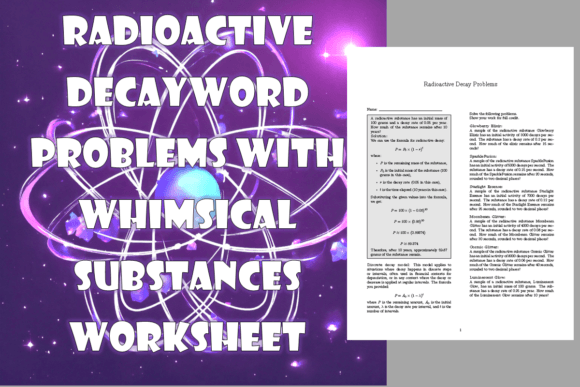
Whimsical Radioactive Decay Worksheet
Physics education often struggles with a specific hurdle: the gap between abstract mathematical formulas and tangible reality. For many students, the concept of half-life feels like a sterile calculation disconnected from the world around them. The Whimsical Radioactive Decay Worksheet bridges this divide by replacing standard isotopes with imaginative substances like Glowium, Radiogoo, and Sparklon. This approach does not dilute the rigor of the science; instead, it wraps complex exponential decay problems in a narrative that demands attention and fosters deeper cognitive engagement.
This resource is more than just a set of math problems. It is a pedagogical tool designed to transform the learning curve for high school and college students. By integrating engaging narratives featuring imaginary elements, the worksheet balances strict academic requirements with creative storytelling. Students are tasked with decoding the intricacies of radioactive decay processes using the exponential decay formula, turning what could be a dry exercise into an exciting adventure. The result is a comprehensive resource that consolidates understanding while sharpening analytical prowess.
The Power of Narrative in Scientific Learning
Why introduce fictional elements like Radiogoo into a physics curriculum? The answer lies in cognitive load theory and memory retention. When learners encounter a problem involving "Glowium," their brains create a unique mental hook. Unlike the generic "Substance X" found in traditional textbooks, a name like Sparklon carries personality. This subtle shift allows students to visualize the decay process more vividly.
In the context of the Whimsical Radioactive Decay Worksheet, these names serve as anchors for the mathematical concepts. As students compute decay rates, half-lives, and residual quantities over time, they are not just manipulating variables; they are tracking the life cycle of a specific, memorable entity. This immersion helps solidify the connection between the abstract formula and the physical phenomenon it represents. The numbers and substances utilized were specifically created for this resource to cultivate a vivid and memorable learning journey, where knowledge acquisition becomes an immersive experience rather than a rote memorization task.
Mastering the Exponential Decay Formula
At the heart of this educational tool is the exponential decay formula: P = P0 × (1 - r)^t. While the setting is whimsical, the mathematics remains grounded in rigorous scientific principles. Understanding this equation is crucial for grasping decay rates pertinent to environmental contexts, nuclear physics, and even financial modeling.
- P: Represents the final quantity remaining after a specific period.
- P0: Denotes the initial quantity at the start of the observation.
- r: Stands for the decay rate, a critical variable determining how quickly the substance diminishes.
- t: Symbolizes time, the independent variable driving the change.
The worksheet challenges students to manipulate these parameters across various scenarios. For instance, a student might calculate how much "Radiogoo" remains after three days given a 15% daily decay rate. Another problem might require solving for the time t needed for "Sparklon" to reduce to half its original mass. These exercises give a substantial boost to mathematical skills, forcing learners to apply algebraic reasoning within a dynamic context. The primer introduces learners to this formula as the mathematical foundation, ensuring they can translate real-world—or whimsical-world—observations into solvable equations.
Creative Applications for Educators and Creators
Beyond the classroom, the Whimsical Radioactive Decay Worksheet offers a blueprint for creators, designers, and educators looking to innovate. The core idea—using narrative to simplify complex data—is applicable across numerous fields. Consider how a marketer might use similar techniques to explain product lifecycle or inventory turnover, or how a game designer could implement these mechanics into an RPG's alchemy system.
Adapting the Concept for Different Audiences
Educators can adapt this framework for diverse audiences. For younger students, the focus might remain on the story of the substances, using visual aids to represent the decay. For advanced high school or college students, the narrative serves as a vehicle for introducing calculus-based approaches to decay rates or stochastic models. The flexibility of the "whimsical" element allows the difficulty level to scale without changing the underlying structure of the lesson.
Freelancers and content creators can also draw inspiration from this format. Imagine an interactive blog post or a social media series where followers solve weekly puzzles involving fictional elements to learn about sustainability or climate change. The key is maintaining the balance between the fun of the narrative and the integrity of the data. By keeping the results clear and effective, creators ensure that the audience walks away with genuine insights, not just entertainment.
Variations and Project Ideas
To keep the material fresh and relevant, consider exploring variations on the theme. Instead of radioactive decay, apply the same exponential model to population growth, viral marketing spread, or battery degradation. You could create a "Whimsical Population Growth Worksheet" featuring creatures like "Bloom-Bugs" or "Rapid-Rats."
- Interactive Digital Modules: Convert the worksheet into a web-based simulation where users adjust sliders for r and t to see real-time changes in the quantity of Glowium.
- Role-Playing Scenarios: Develop a classroom activity where students act as scientists managing a containment facility for unstable substances, requiring them to calculate safe storage times based on decay rates.
- Cross-Disciplinary Projects: Combine physics with art by having students design the visual appearance of their imaginary substances and illustrate their decay stages, linking mathematical precision with creative expression.
Ensuring Clarity and Consistency in Design
When adapting such resources, clarity is paramount. The whimsical nature of the content should never obscure the learning objectives. To maintain effectiveness, ensure that the terminology used for the fictional substances is consistent throughout the material. If "Glowium" has a specific decay rate in one section, it must remain constant unless explicitly stated otherwise. This consistency prevents confusion and allows students to focus on the mathematical relationships rather than deciphering changing rules.
Furthermore, organize the problems logically, starting with direct applications of the formula and progressing to multi-step word problems that require synthesis of information. Use clear headings and distinct sections to guide the learner through the increasing complexity. By keeping the layout organized and audience-friendly, you respect the user's time and cognitive effort. The goal is to make the learning journey seamless, where the transition from story to solution feels natural and intuitive.
Practical Recommendations for Implementation
For those looking to implement or create similar resources, start by defining the core learning outcome. Is the goal to master the algebra of exponential functions, or to understand the conceptual nature of half-life? Once the objective is clear, build the narrative around it. Choose names and properties for your substances that evoke curiosity but do not distract from the math.
Always provide a worked example before asking students to solve problems independently. In the case of the Whimsical Radioactive Decay Worksheet, a detailed walkthrough of calculating the remaining amount of Radiogoo after a specific timeframe sets the stage for success. Encourage peer review and discussion, allowing students to share their interpretations of the whimsical scenarios. This collaborative approach deepens understanding and makes the abstract concrete.
Ultimately, the value of this approach lies in its ability to humanize hard science. By treating the subject matter with creativity and care, we invite learners to engage with physics not as a barrier, but as a fascinating realm of discovery. Whether you are an educator designing a curriculum, a blogger creating engaging content, or a hobbyist exploring new ways to teach, the principles behind the Whimsical Radioactive Decay Worksheet offer a powerful template for innovation. Embrace the potential of imagination to illuminate the facts, and watch as your audience transforms from passive observers into active explorers of knowledge.