Thesis Defense Psychology Google Slide
Presenting a thesis defense is one of the most significant milestones in an academic career, yet the pressure often extends beyond the research itself to how that research is communicated. For students and professionals in psychology, therapy, and related health sciences, the visual narrative can be just as critical as the data. The Thesis Defense Psychology Google Slide template offers a structured, visually cohesive way to present complex findings without getting lost in design distractions. It bridges the gap between rigorous academic requirements and modern presentation standards, ensuring that your hard work shines through clearly.
Understanding the Purpose of Specialized Presentation Templates
A specialized template like the Thesis Defense Psychology Google Slide is more than just a collection of colorful slides; it is a strategic tool designed to align with the specific needs of mental health and academic presentations. Unlike generic templates that might feature corporate charts or unrelated imagery, this resource is tailored to topics such as anxiety, depression, self-care, and clinical case studies. It incorporates a minimalist and elegant aesthetic that reflects the sensitivity required when discussing human behavior, mental well-being, and medical research.
The core value lies in its ability to standardize the visual language of your defense. Whether you are presenting a qualitative study on patient experiences or a quantitative analysis of treatment efficacy, the template provides a consistent framework. This consistency helps the audience—often a panel of experts—focus on your methodology, theoretical framework, and conclusions rather than deciphering disjointed layouts. By using a tool built for these specific contexts, you reduce cognitive load for both the presenter and the listeners.
Why Different Audiences Value This Resource
The utility of a high-quality presentation template varies significantly depending on who is using it. While the primary user is likely a graduate student, the benefits extend to educators, researchers, and even healthcare professionals looking to present case studies or training materials.
For Graduate Students and Researchers
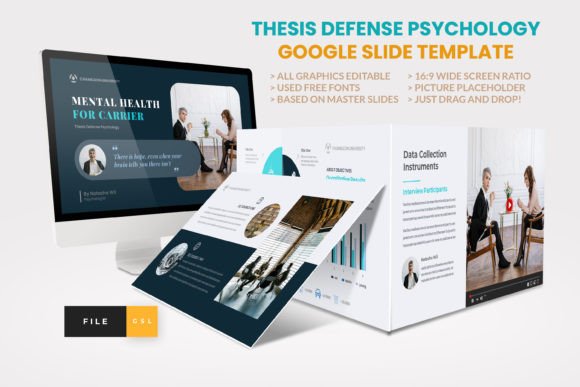
For PhD candidates and master's students, time is a scarce resource. The last thing anyone wants to do during the final weeks before a defense is struggle with alignment tools or choose color palettes. The Thesis Defense Psychology Google Slide template solves this by offering 36 pre-designed slides that cover every section of a standard dissertation defense: Objectives, Literature Review, Hypothesis, Methodology, Results, and Conclusion.
Students can focus entirely on refining their arguments and rehearsing their delivery. The inclusion of picture placeholders allows for easy drag-and-drop functionality, meaning graphs, statistical models, or anonymized case study images can be inserted instantly. For those conducting mixed-methods research, the flexibility to resize graphics ensures that both survey data and interview excerpts look professional side-by-side.
For Educators and Academic Advisors
Teachers and university professors often need to demonstrate what a successful presentation looks like to their students. Using a template like this serves as a practical teaching aid. It sets a benchmark for quality and structure. Furthermore, educators may use these slides for their own lectures on research methods or to present their own scholarly work at conferences. The "Master Slides" feature ensures that any changes made to the theme propagate throughout the deck, saving hours of manual editing when updating course materials or conference talks.
For Healthcare Professionals and Therapists
Beyond the university walls, this template finds relevance in the broader healthcare sector. Clinicians, physiotherapists, and mental health practitioners often need to present case studies to colleagues, insurance panels, or charity boards. The themes of awareness, care, and disease management inherent in the design make it suitable for non-academic but professional settings. A therapist presenting a new intervention strategy can leverage the clean, professional layout to convey credibility and empathy simultaneously.
Evaluating Priorities: Quality, Flexibility, and Ease of Use
When deciding if the Thesis Defense Psychology Google Slide matches your needs, several key priorities come into play. These factors determine whether a template will serve as a long-term asset or a temporary fix.
- Ease of Use: The template is built on Google Slides, which eliminates the need for expensive software licenses. The interface is familiar to most users, and the documentation file included ensures that even beginners can navigate the features quickly. The drag-and-drop picture placeholders simplify the process of adding visual evidence.
- Flexibility and Customization: With 36 total slides, there is ample room to expand or condense content based on your specific word count or time limit. All graphics are resizable and editable, allowing you to adapt the layout for different screen sizes or printing requirements. The recommended free web fonts ensure that typography remains legible and stylish across different devices.
- Professional Quality: In academic and medical fields, appearance signals competence. The modern, elegant, and unique layouts avoid the clichés of clip art, opting instead for a corporate and agency-style aesthetic. This level of polish is crucial when defending a hypothesis to a skeptical committee or pitching a research project to potential funders.
- Cost and Accessibility: As a digital product available in both Google Slides and .PPTX formats, it offers high commercial value relative to hiring a graphic designer. It provides a professional look at a fraction of the cost, making it accessible for students on tight budgets and small agencies alike.
Practical Application Across Different Scenarios
To understand how this tool fits into real-world workflows, consider how different users might approach a project.
The Beginner Student: A first-time presenter might feel overwhelmed by the sheer volume of information they need to share. They would benefit from the structured flow of the template, which guides them logically from the introduction to the conclusion. The predefined sections for "Theoretical Framework" and "Literary Review" act as prompts, ensuring no critical component is forgotten.
The Experienced Researcher: A seasoned academic might not need the structural guidance but values the speed. They can import their existing text and data into the slide placeholders within minutes. The ability to edit master slides allows them to quickly apply their institution's branding or specific color codes while maintaining the underlying sophisticated layout.
The Creative Professional: A marketer or blogger focusing on mental health awareness might use this template for a webinar or a client pitch. The "Creative Presentation template" aspect allows them to tell a compelling story about self-care or disease prevention without needing design skills. The 16:9 wide-screen ratio ensures compatibility with modern projectors and video conferencing tools like Zoom or Teams.
Determining If This Template Fits Your Goals
Not every presentation requires a specialized academic template. However, if your goal involves presenting research, case studies, or educational content related to psychology, health, or education, the Thesis Defense Psychology Google Slide is likely an excellent match. It is particularly well-suited for projects where clarity, professionalism, and adherence to academic standards are paramount.
If you are a hobbyist creating a casual slideshow about personal wellness, a simpler template might suffice. But for anyone facing a formal defense, a grant application, or a professional review, the depth of this resource—from its comprehensive slide count to its semantic alignment with psychological themes—provides a distinct advantage. It transforms the daunting task of visualization into a streamlined process, allowing the substance of your work to take center stage.
Ultimately, the right presentation tool should empower you to communicate your ideas effectively. By leveraging a design that understands the nuances of your field, you can approach your defense with confidence, knowing that your visual presentation supports the integrity and depth of your research.